Showing posts with label T1D. Show all posts

5/08/2012

A story

If You Give a Girl a Test Strip
written by: Amy Berger, artificial pancreas
unfortunately a non-fictional tale


If you give a girl a test strip,

she'll want a poker to go with it.

So you will give her a poker and her PDM and she will test her blood sugar.

When she tests her blood sugar,

she will be low and want some juice to make her better.


When the girl is feeling better,

you will give her another test strip to check her blood sugar once more.

When you give her the test strip,

you will realize it is the last one from the container.


Since it is the last one from the container,

you will send your girl to the supply cabinet to get some more strips.

When she looks for more strips,

she will notice there are only 4 containers remaining.

4 containers remaining means it is time to place a reorder.


When you log on to the computer to place a reorder,

the screen will flash a warning: "Cannot fulfill request".

Not being able to fulfill the request,

the computer will prompt you to call a number.


Calling that number will result in a grumpy lady telling you they no longer contract that brand of test strip.

You will tell the grumpy lady your girl NEEDS that particular test strip because it is the only one that works in with her insulin pump.

Hearing about the insulin pump will cause the grumpy lady to stutter and place you on hold . . .

. . . indefinitely.


While you are on hold, your girl will ask for another test strip,

and she'll want her poker to go with it.

You'll give her a poker and her PDM and she will test her blood sugar.

When she tests her blood sugar,

she will be high and want a correction to make her feel better.


Making a correction will remind you she needs to test again in a bit,

and testing again will make you realize you are still on hold for a reorder.

A reorder is not going to happen with this phone call (according to the grumpy lady, you need to call your insurance company),

So you hang up the phone and search for your insurance card.


Searching for your insurance card will cause you to dig deep into your purse,

and deep in your purse is where you will find more test strips.

but those test strips are already used and therefor of no use.

Being of no use will remind you how scary it would be to be without them,

so you find the number on your insurance card and start dialing.


Dialing the number will result in getting lost in a maze of automated menu options.

The menu options are never exactly what you need,

so you press '0' for an operator,

And wait, wait, wait some more for a real, live person.


A real, live person gets on the line and states you need to file an appeal for the test strips.

Filing an appeal means you have to call the Endocrinologist.

Calling the Endocrinologist will mean you have to leave a message,

and leaving a message means you can get of the darn phone!


Getting off the darn phone will make your girl happy.

Making your girl happy will remind her she is hungry.

When she is hungry she tells you what she wants and you count up the carbs.

Counting up the carbs means she needs to enter that number into her insulin pump.


Entering carbs counts into her insulin pump will remind her she needs to test her blood sugar,

and if she tests her blood sugar she will need to use another test strip.

Using up another test strip will remind you to place a reorder,

And placing a reorder is getting complicated.


Complicated tasks make you frustrated,

and getting frustrated makes you want a cookie (or ten).

If you get a cookie, your girl will want one, too.

If she gets a cookie, she will have measure the carbs, test her blood sugar, and enter the data into her PDM.

Testing her blood sugar will use another strip,

and using another strip reminds you the stash is dwindling.


The dwindling stash will cause you to check your phone messages.

 Your messages reveal the Endocrinologist called back.

The Endocrinologist says they will be happy to fax an appeal,

and faxing an appeal should result in a reorder.


A reorder will remind you it is time to test your girl's blood sugar.

Testing your girl's blood sugar is necessary because she has been  jumping on the trampoline.

Jumping on the trampoline causes her blood sugar to drop,

and a drop in blood sugar could be dangerous, so you go get another test strip.


While getting another test strip,

you stop by the computer to check the status of the appeal.

The status of the appeal reads "DENIED",

and being denied makes you cRaZy.


Being cRaZy does not allow you to be a good artificial pancreas.

Being a good artificial pancreas means you get back on the phone,

and getting back on the phone results in talking to more stupid people.

Talking to more people reveals your policy has an "exclusion",

and this "exclusion" protects the insurance company,


Protecting the insurance company means setting limits on policy holders,

setting limits on policy holders means my girl can't get what she needs.

If my girl doesn't get what she needs, she will get very sick.

Getting very sick will cause her to go to the hospital,

and going to the hospital will cost the insurance company lots of money.


(WAIT.  I'm confused.  The insurance company doesn't want to pay for a 3 cent test strip, which costs us a dollar a piece over the counter, for preventative care?  Won't they save more money by keeping my girl healthy?)


So, if you rant and rave and pull out the can of whoopa*#,

The can of whoopa*# will cause someone to listen.

Causing someone to listen will produce understanding,

and understanding will yield some common sense.


Some common sense will result in your husband's corporate HR manager to make a phone call.

Making a phone call will change your policy,

and changing your policy means the appeal is 'APPROVED'

Being approved means your reorder has been placed.


Placing the reorder will remind you your girl needs to test her blood sugar,

and testing her blood sugar will require a test strip . . .


The End Never Ending Story

*The only way to end this destined-to-be-a-series of wretchedly written stories is to discover a CURE for my girl's T1D.  Do what you can so I don't have to pen another tale.  It is for the best, really, that I don't have to write another. 

4/12/2012

a little is a lot


Really, I am!  I came home yesterday from Ellie's Endo appointment and was so excited to post about the decrease in her HbA1c results.  I finished my post toting the AWSCHUMNESS of switching to Apidra and lamenting how Ellie's last result of an 8.0 wasn't bad, but certainly wasn't good.

It wasn't until a facebook friend mentioned she was praying for a better HbA1c number that I realized I never gave the result of yesterday's blood test.

I have a valid excuse, however.  Those 2+ hour appointments wear me out!  So much information crammed into a relatively small amount of time.  So much anticipation for such a small little blood test result.  A little amount of stress turns into a lot amount of tired.

Back to the appointment:

Our most favorite nurse in the whole wide world had us guessing at the new HbA1c number.  A big cheesy grin on her face indicated the number was lower.  Just to be funny, she had us take a guess at the result.

I chimed in with a hopeful 7.6

Hubby gave a conservative guesstimate of 7.8

Ellie presented with a 'deer-in-the-headlight-stare' and went with my guess.

Nope!  None of the answers matched.

Our nurse grinned and said "LOWER".

7.5?  7.4?  6.8?

Nuh, Uh . . . ::smirky smile::

Weeeeeeeeeeeeeeeeeeeee!

You see, a .8 HbA1c reduction may not appear to be much, but a little is a lot.

An 8.0 means Ellie's blood sugars AVERAGE 183. (her goal is 80-150)

A higher average of blood sugars = higher chances of long term complications.

A 7.2 means Ellie's blood sugars AVERAGE 160.

Closer to goal = closer to better control = better health.

 = AWSCHUMENESS!!!!!

Even if her mother is a major dork.

3/15/2012

pimp my pod

Ellie with her OmniPod Insulin Pump

Ellie chose the OmniPod Insulin Pump because she loved the auto-insertion, the tubeless design, and that the pod was waterproof.  She has been proudly pumping insulin since August of 2011. Here is a video we took of her first pod change last July, during her week-long saline trial.

Ellie wears the pod on her stomach, the back of her arms, and on the top of her bum cheeks. Changing the pod site every three days means she has lots of opportunities to decorate the replacement pod (the pod itself is disposable after wearing for 3 days) with stickers and Sharpie designs.

Other Omnipod pumpers personalize their pods, and some even keep the spent pods and use them as decorations and art projects.


Nate over at Houston . . . We Have a Problem likes to decorate his pods, and is kind enough to let his sisters in on the project.


Leighann over at D-Mom*Blog decorates the used pods and uses them as ornaments for her Christmas tree.


Bean from My Sweet Bean and her Pod likes to decorate her doll with a perfectly sized pod so she can be just as sweet as her.

While the stickers, temporary tattoos, and permanent marker personalization work o-k-a-y, Ellie has always wanted something a little more sturdy and re-usable to personalized her pod. These days it is all about personalizing your cell phone, ipod, backpack, t-shirts, etc . . . so why not an insulin pump?

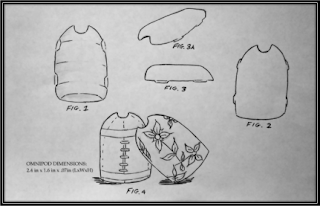
Last night I was browsing my facebook feed and came upon an intriguing update on the OmniPod Group page. A woman named Emily posted a link to her fiance's blog where he wrote a post about designing a product called OmniSkinz.

image from Scott's wordpress blog post
Pimp. Your. Pod. 

Yes, please! I called Ellie over to take a look at the design.  She jumped up and down, clapped her hands, and squealed with delight. "I want those!  Can I, can I, can I . . . can I have all of them, please?!?!"

"Sorry, babe.  These are just prototypes.  They aren't for sale . . . yet", I told her.

I continued to read how Scott came up with the idea, (his fiance, Emily, was diagnosed with T1D and now pumps with the OmniPod) contracted someone to make a prototype, and contacted Insulet, the maker of the OmniPod Insulin Pump, to see if they would be interested in manufacturing the OmniSkinz.

Sketches of the OmniSkinz - personalization

I don't want to miss-quote by summarizing, and I really want you to check out Scott's webpage, so I will give you a link to go and check it out for yourself. 


After reading the article, I encourage you to take the survey and email the Insulet Corporation, telling them you want to see OmniSkinz get to market. (links on Scott's webpage) At this stage, Scott is trying to let Insulet know there IS a demand for this product, and pod customers want personalization for the pod, not just the PDM (personal data manager ~ controls the OmniPod Insulin Pump)

Ellie will live with T1D until a cure is discovered. With that knowledge, her dad and I try to make living with T1D as easy and fun and 'normal' as possible. If she likes these OmniSkinz, then I want to support seeing them manufactured. Even if you, your child, or anyone in your family/friend circle does not personally use an OmniPod Insulin Pump, please take a moment to fill out the survey and let Scott know he has a fantastic idea.

*I do not know Scott personally. I found his website through a facebook link and commented on his blog post. Scott emailed me a reply after I asked a question in his survey, and I emailed back asking if I could post his images, product, and story on my personal blog at three thirty three. Scott did not ask me to write about OmniSkinz, nor will I be compensated in any form for doing so. I support small business and great ideas, so this write-up is my opinion in hopes to see OmniSkinz available for purchase.

3/05/2012

the red box

Goggle Images - glucagon search
**Disclaimer**  The information in this post is in no way shape or form intended to be medical advice.  This is simply a recount of what happened to our family and how we muddled through an illness.  I am writing this in order to have a written account of how we handled this situation, as it will, in all probability, happen again.  I am also writing this for other T1D families who wrote their own stories that provided me the courage to let go my fears of 'the red box'.

*If you are not familiar with Type 1 Diabetes, some words used and procedures followed will not make sense. I apologize in advance for any confusion, however, please stick with the story and learn why we pray for a cure.

 
The red box was first given to me 1 day after Ellie was diagnosed with T1D.  I was at the pharmacy picking up prescriptions Ellie's new endocrinologist informed us would be necessary to treat her T1D . . . the list was long.  Two types of insulin, syringes, alcohol wipes, glucose tabs, blood sugar testing meter and strips, and a red box labeled 'Glucagon Emergency Kit' were all waiting on a counter, along with a pharmacy tech ready to explain each item and their use. 

I knew what every thing was except for the red box.  When the tech picked it up and opened the lid, my eyes focused on a very big needle and a very small vial containing a powdery pill.  The tech went on to explain how to flip open the lid on the vial, un-cap the needle of the fluid-filled syringe, and plunge the liquid into the vial.  She showed me how to slowly swirl the vial until the liquid dissolved the tab until the 'new' liquid was clear.  I was then instructed to draw-up the 'mysery liquid' into the now empty syringe, clear the air bubbles, and proceed to inject my daughter (through any clothing barriers) with the nauseatingly big needle into a large muscle group.

:: blink blink::

"Oh!", she said as she noticed my paling skin and sudden shakiness.  "I am sorry.  I didn't even tell you what this is! It is glucagon. Do you know what this is used for?"

::blink blink::  "No", I managed to squeak.

"Well, your daughter should have this with her at all times.  It is a glucagon emergency kit and she will need it when she has a hypoglycemic episode.  Glucagon is a hormone and it will signal the liver to release any stored glucose (sugar) in the body.  It will help her when she is seizing or has lost consciousness due to a seriously low blood sugar.  You must call 911 after administering" she stated.

:: tears welling up and spilling down my cheeks::  "Um, I haven't learned about this yet.  I don't know what you are talking about.  :: choking on my words and trying to hold back an 'ugly cry' episode ::

"Oh. Well. Um, you need to know about it and understand it and, oh. I am sorry" as she quickly stuffed the red box into a paper bag.  "I am sure your Dr. will explain it again.  Just remember, it is really important" she quipped.

And this is how I came to know about the red box.

Eventually the Dr. and diabetes educator explained the need for the contents of the red box, how to use it, how many red box emergency kits to have around the house (we have 3), and all the other scary details about situations when and where we might need to crack it open.

I shared with anyone Ellie might be with, without her father or me, all about the red box and how 'In An Emergency' one should administer it and call 911.  An emergency such as seizing or losing consciousness.  I believe the red box scared everyone else as much as it did me, but I felt comfortable and 'insured' once we discussed it's use.  "You will probably never have to use it" I told them, "This is just in case . . . ." and the subject was closed.

Ellie was diagnosed with T1D in September of 2010 . . . . and we have not had to even touch the red box except for transport and explanation.  529 days without An Emergency. 

You know where this is going, right?  I am not good with suspense. 

Ellie came down with a stomach virus this past Friday afternoon.
Vomiting and T1D are arch enemies, you see.  Losing fluids/foods causes blood sugar to drop.  Dropping blood sugars cause the body to search for energy. Searching for energy other than sugar leads to feeding off of fat in the body.  Feeding off of fat and other tissues causes the body to produce ketones (a strong acid). Ketones require insulin and water to flush them out of the body.  Insulin causes the blood sugars to fall . . . . do you see where this scenario is headed?  If a T1D makes ketones for too long, they go into Diabetic Ketoacidosis (DKA), which happens quickly and requires immediate medical care.  DKA is the leading cause of death in children with T1D.

So, Ellie started vomiting and I knew we were in for a long and closely monitored night.

We checked blood sugar numbers every half hour and ketone size every 2 hours . . . numbers dropped and ketones slowly increased.

We gave Ellie carb-filled fluids (to raise blood sugars) and so we could give her additional insulin (to lower ketones) . . . . she vomited.

We gave her mints to suck on and ice chips to try and keep her hydrated . . . . she vomited.

We tracked every thing that went in, and everything that came out.


We called her endocrinologist and updated her every two hours in an effort to stay in the comfort of our home vs. going to the hospital.

Our attempts to keep Ellie 'stable' eventually led to thinking about, and then using, the contents of the red box.

As you can see on the whiteboard, around 6pm we were losing the 'balance' battle.  I called the endo. and we discussed options.  One of the options I mentioned included utilizing the contents of the red box to give a mini-dose of glucagon.  If administered correctly, the glucagon would signal her liver to release stored caches of glucose.  We both decided this would be a good way to raise her blood sugar without the risk of her throwing it back up since it would be in the form of an injection and go straight into the blood stream.

While on the phone with the Dr., I slowly broke the seal of the red box and proceeded to follow the instructions for mixing the solution.  The Dr. gave me the dosing instructions necessary for a child Ellie's age and for this particular use.  She then told me to wait 30 minutes, give the glucagon time to work, and recheck Ellie's blood sugar numbers.  We agreed to speak again in 2 hours, or earlier if needed, and hung up the phone. 

I think everything went into slow motion at this next moment. 

I was scared. 

I was nervous. 

I was wanting to back out of the deal. 

Then I looked at Ellie and decided it needed to be done.  A recheck of her blood sugar showed a 54 (not written down) and she was feeling very shaky.

Glucagon filled syringe in hand, I injected Ellie with the contents of the red box. 

I thanked God for my steady hand . . . . and then we waited.

30 minutes later her blood sugar was at a beautiful 110.

The cycle was repeated, unfortunately, one more time.  This time Ellie grabbed the syringe and injected herself in her stomach . . . . letting me know I was a poor "shot-giver" and she would just handle this one.

More phone calls to the Dr. revealed we could repeat the glucagon mini-dose every 30 minutes as needed (the vial, once mixed, is good for 24 hours if refrigerated), but that eventually the stores of glucose in Ellie's system would be used up and the contents of the red box would no longer be affective.

In other words, we were reaching the end of our stay at home.

By 10pm, Ellie's ketones were measuring very large and she needed more insulin than we felt safe dosing, given the fact she was still vomiting.

The Dr. graciously called the ER and explained the situation so we could show up and be sent back right away.  The ER nurse and Dr. on duty were familiar with T1D in children and were extremely accommodating to my needs to still pancreate.

An IV was placed (after a failed one) and Ellie received a bag of fluids along with a dose of Zofran, (anti-nausea drug) while the lab tested blood work to check for enzyme stability and presence of DKA.

Within 15 minutes Ellie's color returned to her face and she perked up with conversation.  At one point, she looked over at me and said, "Mom, I am glad we came here".  Yep, baby, so am I.

The labs came back clear for DKA and her enzymes were still behaving.  Ellie drank 4oz. of apple juice in order to fend off a low blood sugar and we waited to see if it would come back up.

The juice stayed down and Ellie continued to improve, so the Dr. on duty called the endo. and we were given the option to be admitted if we wanted.  Or, she said Ellie should continue to improve and so we could go home to rest and recover.

We went home and were tucked neatly in bed (yes, I DID have her sleep with me) by 3am, with order to check numbers every 2 hours.

By mid-morning the events from the previous 24 hours were becoming a memory and Ellie was resting comfortably. I took a nap and watched a movie and basically tried to forget all about what just happened.

And we lived happily ever after, the end.

Until next time.

I did learn one very important lesson, however, . . . .

I am no longer afraid of the red box.  I learned it is simply another tool in the box of supplies we use to care for Ellie's T1D. 

I can fear the 'situation' in which we need to use the contents of the red box, but not fear the box itself. 

Opening it does not mean Ellie is in danger, it means we have a tool to use to get her OUT of a dangerous situation.

Someday, somehow, someone will discover a cure for T1D . . . and for THAT I will sing my praises of gratefulness from the rooftops.

Until then, I will continue to carry the red box . . . . but now without fear.